Tampilkan postingan dengan label khmer news. Tampilkan semua postingan

Selasa, 01 Februari 2011

Internet cut as Egypt braces for 'march of millions'


A man holds a sign up following prayers in Tahrir Square in Cairo on the seventh day of mass protests.
February 1, 2011
By the CNN Wire Staff


STORY HIGHLIGHTS
  • Google says its "speak-to-tweet" service could help Egyptians communicate, despite restrictions
  • Major demonstrations are planned for cities throughout the country
  • Mubarak's vice president promises reform
  • The military pledges not to shoot peaceful protesters


Cairo, Egypt (CNN) -- Egypt's government has posted troops at key locations and cut internet service as anti-government protesters planned a "march of millions" Tuesday.

Activists pledged to hold major demonstrations in cities throughout the country -- a week after rallies began calling for President Hosni Mubarak's resignation.

But Mubarak, who has ruled Egypt for nearly 30 years under a sweeping emergency decree, has given no indication that he plans to give up power.

His government planned to shut down mobile phone networks, closed banks and schools and continued a curfew in preparation for Tuesday's protests.


Protesters have defied previous curfew orders. And late Monday night, Google announced a new technology option that could help Egyptians get around restrictions on mobile phone and internet service.

The new "speak-to-tweet" service allows people without an internet connection to leave a voice-mail message, which will automatically be turned into a tweet, according to a description on Google's blog.

The political turmoil has paralyzed commerce and disrupted daily life in Egypt.

State television reported Monday that the crisis has cost the country an estimated 69 billion Egyptian pounds (nearly $12 billion) and set its economy back six months.

ATM screens went dark. Gas stations ran out of fuel. Long lines snaked around bakeries and supermarkets as shops began to ration how much food customers could buy. Men with makeshift weapons guarded neighborhoods, creating checkpoints to fill the void left when police stopped patrolling the streets.

At demonstrations last Friday, thousands of riot and plainclothes police clashed violently with protesters in a brutal crackdown.

Since then, troops from the country's powerful military have had a strong presence in the streets as largely peaceful protests continued.

The military announced Monday evening that it recognized "the legitimate demands of the honest citizens" and would not open fire on peaceful protesters.

"The presence of the armed forces in the Egyptian streets is for your benefit to protect your safety and peace," an unnamed spokesman announced on state television Monday night. "Your armed forces will not use violence against this great people, who have always played a significant role in every moment of Egypt's great history."

Troops have been mingling with demonstrators in Cairo's Tahrir Square, a focal point for anti-government protests.

"There is no aggressive behavior from the army toward the peaceful assemblies," human rights activist Ramy Raoof said early Tuesday. "We hope that within a few hours, the same also will happen. We hope the army will not escalate violence against us."

Mubarak imposed an emergency decree after the 1981 assassination of his predecessor, Anwar Sadat. A wave of protests against his regime erupted following the uprising in Tunisia that ousted its longtime strongman January 14.

While it's difficult to ascertain a solid death toll during the unrest , Human Rights Watch staffers have confirmed 80 deaths from two hospitals in Cairo, 36 deaths in Alexandria and 13 fatalities in Suez, said Human Rights Watch researcher Heba Morayef.

The Egypt protests started after weeks of similar disturbances sparked a revolution in Tunisia and forced then-President Zine El Abidine Ben Ali to flee the country. There have also been protests in Algeria, Yemen and Jordan since the unrest started in Tunisia.

Egypt and Tunisia have seen dramatic rises in the cost of living in recent years as well as accusations of corruption among the ruling elite.

While it was widely believed Mubarak was grooming his son, Gamal, as his successor, that plan now has been complicated by demands for democracy.

Mubarak fired his Cabinet on Saturday and his designated longtime intelligence chief Omar Suleiman as vice president -- the first time he has filled that post since he came to power in 1981.

Suleiman announced Monday that he had begun discussing reform with opposition parties. Speaking on the state television network, Suleiman said a reform package should be drawn up "expeditiously." "The other parties will also have a role to play, which will lead to real political reform," Suleiman said.

But there were no details of what proposals might be on the table, nor was there any immediate reaction from opposition figures or any indication of which parties were taking part.

Several opposition movements have been represented on the streets in the demonstrations.

Mounir Fakhry Abdel Nour, secretary-general of the Wafd Party, told CNN the group's followers have been "extremely active."

But Raoof, the human rights activist, said that many people with different perspectives were banding together around a common goal.

"There is no political group leading the people. There is no one leading the people. People are going in a very organic way ... people are just doing it," he said.

CNN's Ben Wedeman, Frederik Pleitgen, Ivan Watson, Housam Ahmed, Caroline Faraj, Salma Abdelaziz, Saad Abedine, Christine Theodorou, Zain Verjee and journalist Ian Lee contributed to this report

'Plan to disperse rally' revealed


People's Alliance for Democracy (PAD) co-leader Chamlong Srimuang read a sign criticising Prime Minister Abhisit Vejjajiva.

1/02/2011
Bangkok Post

The government has a three-stage plan to disband the yellow-shirt protest outside Government House, People's Alliance for Democracy (PAD) co-leader Chamlong Srimuang said on Tuesday.

Maj Gen Chamlong said the government would send senior police officers to ask the yellow-shirt protesters to unblock roads when there is little traffic in actuality.

The police had intentionally turned on the red lights longer, causing people to be frustrated with the rally.


The government would then send undercover agents into the rally to stir up confusion and conflicts among the yellow-shirt group.

The final stage would be the deployment of more police personnel to launch a crackdown on the protesters, he said.

"The government's attempt will fail because the PAD will not go anywhere unless the government accedes to our three demands," Maj Gen Chamlong said.

He said the government should concentrate on the Thai-Cambodian issues instead of focusing on the yellow-shirt protesters.

"As a professional demonstrator, I can affirm that our rally will not end. If our rally is dispersed today, we can start again tomorrow.

"If the government refuses to protect our country we won't end our rally," he added.

The yellow-shirt key member said he lost count of the amount of lies Prime Minister Abhisit Vejjajiva made regarding the Thai-Cambodian border issues.

The government began to take action when the PAD revealed the information about the Cambodian flag being hoisted near Preah Vihear temple, he said.

However, he said, the government should not be too relenting with Cambodia.

The PAD started its peaceful protest outside Government House since last Tuesday, pressing the government to withdraw from the Unesco World Heritage Committee, scrap the memorandum of understanding on the Thai-Cambodian border signed in 2000, and expel Cambodian people from disputed border areas.

Sacrava's Political Cartoon: The Coward Prince


Cartoon by Sacrava (on the we

"Neak Srei Chantha Kloach Psa Pruos Akphivat" a Poem in Khmer by Nore Yutt

"Samraek Beh-daung Anatha" a Poem in Khmer by Sék Serei

Event of KC 50 in Kampuchea Krom

Minggu, 30 Januari 2011

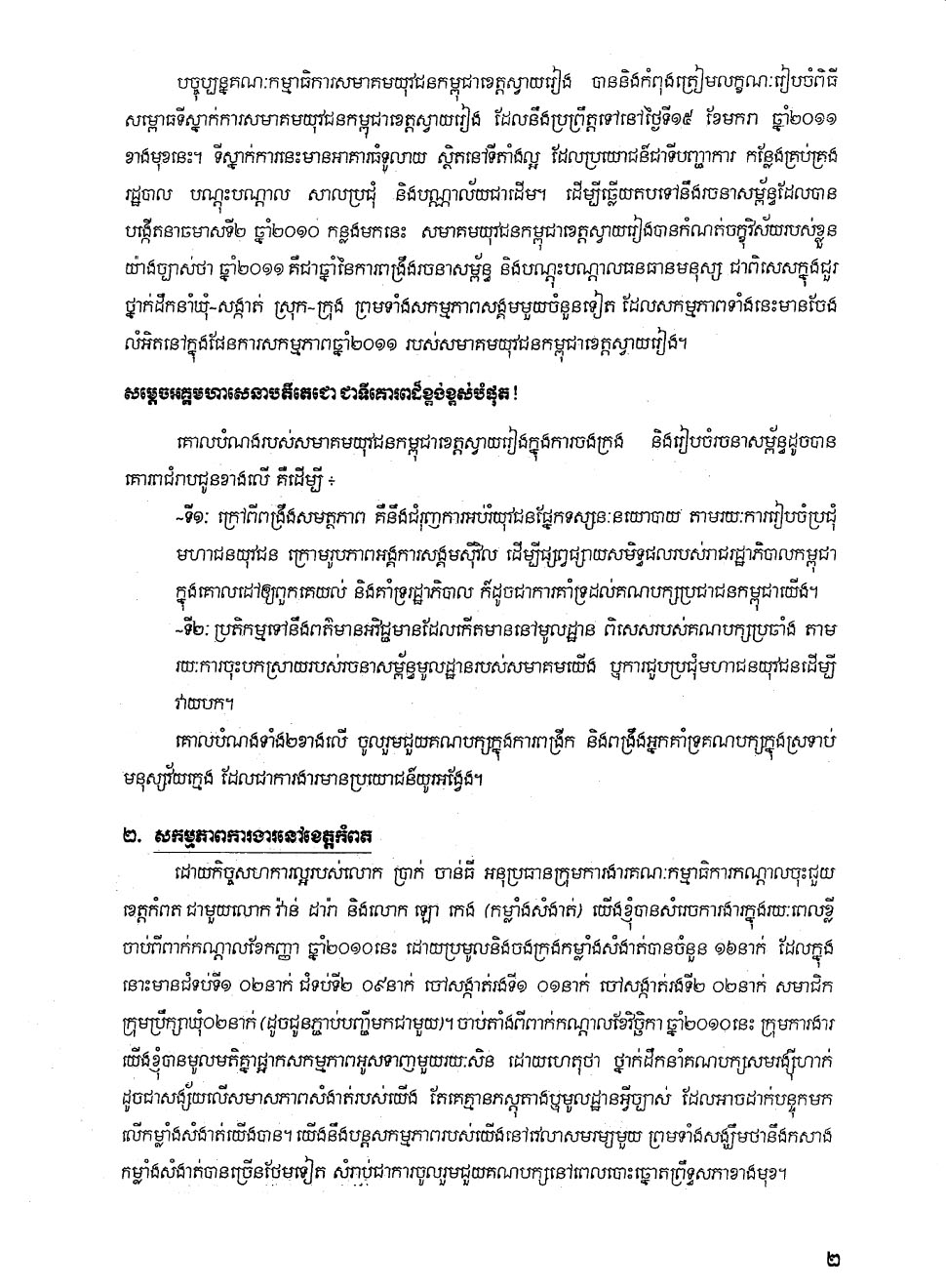
CPP secret document bearing Hun Xen's annotation: The CPP resorts to buying SRP activists for $30/month a piece


Dear Readers,

Please find below a secret CPP document penned by Ngo Sovann, a former SRP defector to the CPP, detailing the CPP secret activities to buy SRP activists in various provinces. The cost of the buyout? About $30/month each (100,000 riels in cash, ~$25, and $5 in phone call card).

With the CPP boasting its popularity in the entire country, one has to wonder why does it need to buy these SRP activists? Strange isn't it? What is most amazing is the fact that these activities are fully known by Hun Xen, the boast-in-chief himself.

There's always something new to wonder in this Kingdom of Wonderfully corrupt CPP politicians ...

KI-Media team

Click on each page to zoom in


Jumat, 28 Januari 2011

Just do as we demand, PAD tells govt


Flagging trouble: Thai troops are under pressure to remove a Cambodian national flag flying above the entrance to Kaew Sikha Khiri Sawara temple, located about 300 metres from the ancient Preah Vihear temple. Villagers have reportedly flown the flag alongside Buddhist flags for years.
Chamlong rejects offer of talks on Cambodia

29/01/2011
Bangkok Post

The People's Alliance for Democracy has rejected the government's proposal for negotiations to end its rally.

It made its decision after the government proposed to send a delegation to hold talks to clear the air over the Thai-Cambodian border issues.

PAD core leader Chamlong Srimuang yesterday said any talks would be a waste of time.

He said government representatives had called and offered to hold a live debate.

``It is not time for talks. The government should comply with our demands,'' he said.


Maj Gen Chamlong also voiced disagreement with the plan of Chaiwat Sinsuwong, a core leader of the PAD-linked Thai Patriots Network (TPN), to bring in the red shirts to strengthen the anti-government rally.

Maj Gen Chamlong said the PAD would not get involved with the TPN's business.

The PAD has been protesting against the government by blocking Ratchadamnoen Nok Avenue since Tuesday over its handling of Thai-Cambodian border disputes.

The group is demanding Thailand's withdrawal from the Unesco World Heritage Committee, the revocation of the 2000 MoU signed with Cambodia and ejecting Cambodians in border areas the group claims belong to Thailand back to their homeland.

Government spokesman Panitan Wattanayakorn said the government has put together a team to clarify the issues to PAD leaders with staff from the Foreign Ministry as core speakers.

Prime Minister Abhisit Vejjajiva has stressed the need to hold talks with the yellow shirts to clear up any confusion and get the facts straight, he said.

``The longer the protest the worse it becomes for all parties concerned.

``The government has a team ready to talk with the PAD. They are people in charge of border issues,'' Mr Panitan said.

He said authorities cannot allow the rally and must enforce the law to keep protesters away _ a step the government hopes it will not have to take.

Deputy Prime Minister Suthep Thaugsuban said yesterday the prime minister is expected to lead the talks after his return from Switzerland where he is attending the World Economic Forum _ if the PAD agrees.

Mr Chaiwat said he had asked key members of the red shirt United Front for Democracy against Dictatorship to joint the TPN in its fight against the government. He said that while he was in jail he had discussed with the detained red shirt leaders ways to protest against the government.

``I told them that the TPN will continue rallying at the No.4 entrance gate of Government House and the yellow shirts will protest on Ratchadamnoen Avenue.

``I asked the red shirts to gather at Orathai bridge near the prime minister's office building compound,'' Mr Chaiwat said.

The red shirt key figures said they would have to discuss the matter with other leaders before making any decision, he added.

Meanwhile, the 2nd Army is seeking the removal of a Cambodian national flag at the entrance of Kaew Sikha Khiri Sawara temple next to the ancient Preah Vihear temple.

A border source said that 2nd Army commander Thawatchai Samutsakhon has been talking to local Cambodian military leaders about removing the flag. The move comes after the prime minister's order and public pressure.

Just days ago, Thailand persuaded Cambodia to demolish a stone tablet reading ``Here! is Cambodia''.

According to the source, the Cambodian military denied putting up the flag at the temple's entrance.

It was placed there by local villagers.

Lt Gen Thawatchai, the source said, feels uncomfortable about this as it is almost a non-issue.

``First the tablet. Now the flag decoration. They should think about the troops working with their Cambodian counterparts in the area,'' said the source.

The flag is neither a sign nor a claim that it is Cambodian territory, the source said.

It was there before Thai troops were deployed at the temple in July 2008 when border tensions escalated.

Egyptian military deploys in Cairo under curfew


An Egyptian protester throws stones towards a line of riot police in Cairo on Friday. (Victoria Hazou / AP)
A female activist shouts at anti-riot policemen who blocked the way to a journalists' syndicate in downtown Cairo on Jan. 26. (Ben Curtis / AP)
Ruling party HQ ablaze; protesters climb on tanks in Suez; Nobel Prize winner under house arrest

2011-01-28
NBC, msnbc.com and news services NBC, msnbc.com and news services

CAIRO — Shots were heard in central Cairo on Friday after military units moved in to quell an "open revolt" against President Hosni Mubarak's 30-year rule by tens of thousands of protesters.

Demonstrators were trying to storm the foreign ministry and the state TV building in Cairo, The Associated Press reported. Violent clashes were also reported near the Egyptian parliament.

Television images showed several buildings in Cairo, including the headquarters of the ruling party, ablaze. Flames also threatened the Egyptian National Museum.

Friday saw demonstrations across the country, which continued despite a 13-hour military curfew which began at 6 p.m. local time (11 a.m. ET). It initially covered the cities of Cairo, Suez and Alexandria, but was later extended to cover all cities. Demonstrators stayed on the streets in defiance of security forces, some mounting armored cars, cheering and waving flags.


The Al-Jazeera TV network said at least one person was killed, while Reuters reported at least five deaths. Neither could not be immediately verified.

Some 870 protesters were wounded, medical sources said, more than doubling their previous estimate. Medical officials told Reuters 450 protesters were treated on the streets and not taken to hospital, while 420 others were hospitalized.

Nobel Peace laureate Mohamed ElBaradei was put under house arrest after he joined a march earlier in the day. He and scores of protesters were forced to seek refuge in a mosque after police used water cannons and tear gas.

There were also reports that protesters had taken control of central areas of Suez and Alexandria.

Egypt's national carrier said it had also suspended its flights from Cairo for 12 hours. European airlines also modified their schedules for flights to and from Egypt, cancelling some services, due to the curfew.

'Deep concern'

The U.S. State Department said that the situation was of "deep concern," adding that "reform is vital." Secretary of State Hillary Clinton appealed for the government to allow peaceful protests and for the people on the streets to "refrain from violence."

The U.S. also warned citizens to avoid non-essential travel to Egypt and urged Americans in the country to stay put.

Shortly after the curfew began, BBC News reported that tanks had moved in to Suez and Cairo.

NBC News' Richard Engel said people were in "open revolt" on the streets of Cairo.

Engel said many people were praying in the streets, "daring" the police to move against them and enforce the curfew.

After the army moved in, Engel said the troops appeared to be taking "almost no action to stop these protests, to enforce this curfew."

"A scene that could become iconic of the day is unfolding right below me. There's an army APC, an armored personnel carrier. Instead of firing on the protesters or pushing them back, it has been surrounded by protesters … one person is standing on top of it, waving an Egyptian flag," he told msnbc TV.

Engel said the demonstrators did not want to confront the army and realized the Tunisian government had fallen when its army refused to stop the protests.

Some protesters chanted slogans calling for the army to support them, complaining of police violence.

"Where is the army? Come and see what the police is doing to us. We want the army. We want the army," the protesters in one area of central Cairo shouted.

However, Egyptian state television said the military would work in tandem with the police to get people off the streets.

"According to what some provinces witnessed in terms of riots, lawlessness, looting, destruction, attack and burning of public and private property including attacks on banks and hotels, President Hosni Mubarak decreed a curfew as a military ruler," a state TV announcer said.

The protests began when groups of thousands of protesters gathered at at least six venues in Cairo, a city of about 18 million people, and then marched toward major squares and crossed Nile bridges.

"I can't believe our own police, our own government would keep beating up on us like this," said Cairo protester Ahmad Salah, 26. "I've been here for hours and gassed and keep going forward, and they keep gassing us, and I will keep going forward. This is a cowardly government and it has to fall. We're going to make sure of it."

At several confrontation points, police used rubber bullets, batons, water cannons and tear gas against the stone-throwing demonstrators.

ElBaradei, who took to the streets Friday for the first time since his return to Egypt on Thursday, was walking with one group when clashes broke out with police.

They used batons to beat some of his supporters, who surrounded ElBaradei to protect him.

He and protesters were soaked with water cannons and eventually were forced to take refuge in a mosque, where they were trapped by riot police.

Inside the mosque, ElBaradei was prevented from leaving by tear gas. The canisters set several cars ablaze outside and several people fainted and suffered burns.

"We are the ones who will bring change," said 21-year-old Ahmed Sharif, one of scores who were with ElBaradei. "If we do nothing, things will get worse. Change must come," he screamed through a surgical mask he wore to ward off the tear gas.

'Oppression is growing'

Abeer Ahmed, a 31-year-old woman who showed up for ElBaradei with her toddler, said she has a law degree but makes a living cleaning homes.

"Nothing good is left in the country," she said. "Oppression is growing."

ElBaradei later attempted to march again with supporters chanting "peaceful, peaceful."

Hours later, it emerged he was under house arrest. Police stationed outside his suburban Cairo home told him he could not leave the building. It was unclear how he got there.

Speaking to Reuters, one witness described blood streaming from people with head wounds and others collapsing to the ground. Other witnesses gave similar descriptions.

Al-Jazeera also said opposition politician Ayman Nour, who ran in the 2005 presidential election, was hurt. Citing his son, the station said the politician was in intensive care after being hit on the head by a rock.

In Suez, Al-Jazeera reported at least five tanks moved in after the crowd chased away police from the central area of the city.

Dozens of protesters climbed onto the tanks, a Reuters witness said, and tried to talk to the soldiers. One tank had about 25 protesters on it, the witness said.

The troops tried to wave them off and residents also told Reuters that soldiers had opened fire. It was not immediately possible to confirm their reports.

Earlier in Suez, the body of a protester was carried through the streets. "They have killed my brother," one of the demonstrators shouted.

There was also a report that protesters had overcome the police in the Mediterranean port city of Alexandria.

The Guardian newspaper quoted Peter Bouckaert, of Human Rights Watch, as saying: "The police have now given up fighting the protesters. The police and protesters are now talking, with protesters bringing water and vinegar (for tear gas) to the police.

"Now walking down to downtown Alexandria, the whole road is packed as far as we can see, people shouting slogans against Mubarak and his son Gamal ... asking others to join them," he added. "It is a very festive atmosphere. Women in veils, old men, children, I even saw a blind man being led. And there are no police anywhere."

'I want a better future'

There were smaller protests in Assiut, which is located south of Cairo, and al-Arish in the Sinai peninsula.

Regional television stations were reporting clashes between thousands of demonstrators and police in Alexandria and Minya, which is south of Cairo.

"It's time for this government to change," said Amal Ahmed, a 22-year-old protester. "I want a better future for me and my family when I get married."

Friday's protest were by far the largest and most violent since they began Tuesday.

Demonstrators are demanding 82-year-old Mubarak's ouster and venting their rage at years of government neglect of rampant poverty, unemployment and rising food prices.

The protesters have said they are emboldened by the uprising in Tunisia, another north African Arab nation.

Egypt is Washington's closest Arab ally, but Mubarak may be losing U.S. support.

An Obama administration official said Friday the U.S. will review its $1.5 billion in aid to the nation.

The official spoke on condition of anonymity because of the delicacy of the situation. U.S. officials are now increasing calls on Mubarak to respond with restraint and reverse steps taken to cut off the protesters' ability to communicate.

The Egyptian authorities appeared to have disrupted social networking sites, used as an organizing tool by protesters, throughout the week.

Those disruptions escalated Friday, when Internet and cell phone services, at least in Cairo, appeared to be largely cut off.

With two-thirds of Egypt's 79 million people under the age of 30 and with many frustrated by largely toothless opposition parties, many of Egypt's youth have turned to the digital sphere as one of the few channels available to express their anger.

The attempts to sever the protesters lines of communication did not prevent tens of thousands from flooding the streets.

Sinatoons No. 8: Shukaku Inc.


Cartoon by V. Sina

Kamis, 27 Januari 2011

Prison numbers creep up

Photo by: Heng Chivoan
Minister of Interior Sar Kheng speaks during the annual meeting of the Department of Prisons in Phnom Penh today.

via CAAI

Thursday, 27 January 2011 20:18 May Titthara

Prison officials at the Ministry of Interior said today that the number of prisoners increased by 5.1 percent in 2010 compared with a year earlier, putting further pressure on the Kingdom’s overburdened correctional facilities.

Kuy Bunson, deputy director of the ministry’s Department of Prisons, said that as of December 15, 14,043 prisoners were interned in the Kingdom’s jails, 718 up on the previous year.

Of these, 6,836 were incarcerated during the course of 2010.

Speaking at the department’s annual meeting in Phnom Penh today, Kuy Bunson said that due to severe overcrowding in Phnom Penh’s prisons, 669 prisoners were transferred to provincial facilities during 2010.

Overcrowding has long been a problem in the country’s penal system, which has an official capacity of about 8,000.

Kuy Bunson said that in order to alleviate the problem, the government is pushing ahead with plans to expand the country’s overall prison capacity, with new prisons to be established in Pailin and Oddar Meanchey provinces.

They will supplement recently completed facilities in Banteay Meanchey and Prey Veng.

He said the department has also established Correctional Centre 4, its first agricultural detention centre, in Pursat province, constructing four provisional wooden detention buildings that can accommodate 280 detainees.

Officials hope that CC4, opened in January 2010, will eventually hold 2,500 inmates.

“In order to address the small space problem in detention, detainees have participated in industrial and agricultural programmes,” he added.

Nut Sa An, a secretary of state at the Ministry of Interior, said the spike in the number of inmates posed major health concerns and made it difficult to control prisoners.

“Small space in detention results in many issues which impact the implementation of the detention reform strategy, such as [prisoners’] mental and physical health,” he said.

In July, local rights group Licadho reported that Cambodia’s prisons could be the most overcrowded in the world inside a decade without broad-based reform of the country’s criminal justice system.

The report stated that even substantial increases in capacity over the next few years will do little to stop the overcrowding plaguing the country’s penal system.

Am Sam Ath, a senior investigator for Licadho, said some prisons designed to hold 600 prisoners were housing as many as 1,500, contributing to the spread of communicable diseases such as tuberculosis.

“This problem impacts on the detainees’ mental health and blood vessels, which causes them to die from high blood pressure,” he said.

Last year’s increase of 5.1 percent is down on the 14 percent average annual growth in the prison population over the past five years.

But even assuming a five percent annual growth rate – something it described as conservative – Licadho’s report stated that the prison system will still be at 165 percent of capacity in 2019.

Am Sam Ath said the problem derived in part from the justice system, which remands large numbers of suspects in custody rather than granting them bail. Last year, the Department of Prisons reported that about a third of the prison population was made up by defendants awaiting trial.

“If the judges didn’t grant some criminal defendants bail … the building of four correctional centres in Pursat or Pailin provinces would still not be enough for those prisoners,” he said.

Money for nothing

Photo by: Wesley Monts
A money changer holds up US dollars and Vietnamese dong at Central Market in Phnom Penh yesterday.

via CAAI

Thursday, 27 January 2011 21:51 James O’Toole and May Kunmakara

Several weeks ago, staff at ANZ Royal Bank noticed a peculiar customer at one of their ATMs in Phnom Penh.

With a male companion looking on behind her, the woman inserted a card issued by Vietnam’s Techcombank and withdrew the maximum allowable amount of cash, US$2,000.

Then, taking out a new Techcombank card for each transaction, she repeated the task 11 times in succession.

The woman is one of a growing number of Vietnamese nationals who bankers say have been cleaning out the Kingdom’s ATMs, taking advantage of the unusually large gap between Vietnam’s official and unofficial exchange rates to earn thousands of dollars in profits.

ANZ CEO Stephen Higgins said yesterday that Techcombank cardholders had withdrawn roughly $12 million in cash from his bank’s ATMs since mid-December, with the bulk coming in the past two weeks.

They took roughly $5 million from ACLEDA Bank machines from the beginning of the month until yesterday, ACLEDA Executive Vice President So Phonnary said.

All told, Techcombank users have withdrawn “at least $20 million” in cash from Cambodian ATMs in the past few weeks in a scheme that has also stretched to Singapore and China, Higgins said.

“It’s very smart what they’re doing,” he said.

“It’s one of those things where one person figures out this is an easy way to make money, tells a few people who tell a few more people, and suddenly you get busloads of people coming across the border to try and do it.”

The Vietnamese government has pegged the country’s official exchange rate at roughly 19,500 dong to the dollar, though the black market rate – also used legally by money changers in Cambodia – is closer to 21,000 dong to the dollar, a difference of about 8 percent.

The Vietnamese who have been travelling to the Kingdom have taken advantage of this.

At Cambodian ATMs, they receive US dollars that have been converted from the dong in their home accounts at the official exchange rate.

They can then trade these dollars for dong from Cambodian money changers or money changers in Vietnam who use the black market rate, earning the difference with the official rate.

ATM transaction fees eat into these profits, but even accounting for such costs, Higgins said the Techcombank users were likely earning about $20,000 for every $1 million in cash withdrawn.

Techcombank, he added, is uniquely exposed to the scheme.

While most Vietnamese banks charge international transaction fees to make up for the difference between the dong’s official and unofficial rates, Techombank’s fees are unusually low.

As a consequence, it has likely lost “about $1.5 million” from transactions in Cambodia in recent weeks, Higgins said.

An executive at another large bank who asked to remain anonymous said his institution too had seen a marked increase in ATM transactions recently, particularly near the Vietnamese border.

Charles Vann, deputy general manager of Canadia Bank, said he, also, had noticed “a throng of Vietnamese” making withdrawals in recent weeks.

“I don’t think there is any problem for us, as long as they’re genuine and they’re not frauds,” he said.

Although Cambodian banks are not losing any money from the process, the Vietnamese cardholders are creating a nuisance for regular customers who are increasingly likely to find their ATMs out of cash, So Phonnary said. To combat the problem, ACLEDA appealed this week for intervention from international credit card firm Visa.

“We sent the information to Visa in order to get assistance,” So Phonnary said.

“They replied to us, they said there is not any fraud. [Those making the withdrawals] are really cardholders and the cards are actual cards, not counterfeit.”

Despite the lack of response from Visa, ACLEDA moved on Wednesday to block Techcombank cardholders from using its machines, she said.

Higgins said ANZ had conferred with Visa and had concluded that blocking the users unilaterally would violate the companies’ agreement. The bank decided simply to lower its maximum daily withdrawal from $2,000 to $500, and to instruct security guards at its ATMs to be on the lookout for users wielding multiple cards.

“We have taken steps to prevent Techcombank users from accessing our ATMs, and where any of them are found in possession of multiple cards not in their own name, we will be seeking police intervention,” he said.

Two men were arrested yesterday at an ANZ ATM in Dangkor district for holding the cards of other people, he added. “I think any time that someone is there with 12 different ATM cards, it’s not a legitimate transaction,” he said.

Officials at the Vietnamese Embassy could not be reached for comment, nor could those at the National Bank of Cambodia.

Khuoy Kry, head of the Bavet International Border Checkpoint in Svay Rieng province, said travellers were permitted to carry up to $10,000 cash across the border, and that ATM use was “out of our control”.

ANZ has counted more than 500 Techcombank users whose cards have been used in the practice, though the actual number of people performing the transactions is likely lower, Higgins said.

So Phonnary said she was unsure how many had performed the transactions with ACLEDA.

Jayant Menon, a currency specialist with the Asian Development Bank, said in an email that Vietnam had long grappled with the gap between the official and black market exchange rates.

“When exchange rate policy is used to substitute for monetary policy in trying to achieve objectives such as inflation control, the gap between official and unofficial rates can grow over time,” he said.

For those taking advantage at Cambodian ATMs in the meantime, however, it appears the music is about to stop; Higgins said Techcombank was working with Visa to institute new fees for international transactions by next month that would close off the arbitrage opportunity.

“While there’s that big gap between the official rate and the unofficial rate, it’s natural that people are going to try and exploit it,” he said. “I just think more and more people have cottoned on.”

Cambodian odyssey


Carroll du Chateau discovers nothing is as it seems in Cambodia.


Dawn at Angkor Wat, the monuments built between the 9th and 13th centuries by the Khmer empire. Photo / Dean Purcell

Who could resist the little Cambodian girl in the faded frock handing out brochures?

"Please come to our concert," she says in perfect English, brown eyes pleading. "We dance. It's for our orphanage."

To be honest, plenty of tourists walking this chaotic restaurant strip could - and did - ignore her. At 6pm Bar St is a mass of begging and selling.

Here in the heart of Siem Reap, beside the thriving Old Market, the sealed roads are lined with restaurants and bars. Tuk-tuk drivers chat together or lie in their carts, one eye open for business. Employees and volunteers from the city's hundreds of NGOs and fit young tourists on adventure escapades stroll nonchalantly through the crowd, looking for the best place to eat.

And throughout all this, swarms of kids roam the streets selling books and handing out restaurant flyers. Many are missing limbs or are disfigured. Every lunchtime a young boy leads an old blind man up and down between the tables. The old man calls out, "hungry, hungry" while the child scans the tables. If someone catches her eye they're over in a flash.

But this little girl and her friends are different. They look at us with shining eyes, grab our hands and plead with us to come and watch them dance.

The next night Virginie and I are in Mr Pov's tuk-tuk heading out of town to the Cambodian Orphan Family Centre Organisation. It's a long ride past often-smelly night markets, one made up entirely of shoes, sprawling in vast, unloved mountains.

Despite the map in the dog-eared brochure handed out by our little orphan, we get lost. All we've seen are rutted clay lanes, yowling cats, shack-like houses and bare sections covered in trash and rubble. Even Mr Pov seems ready to give up.

But no, Virginie, who works for the European Union in Phnom Penh, is determined. "Try again Mr Pov," she says. "Ask someone."

But Mr Pov is no different from other men. Up and down the tracks we jerk, in imminent danger of being thrown out, or possibly mugged, until at last Virginie insists. "ASK someone, Mr Pov!"

Five minutes later we arrive at a nondescript two-storeyed concrete house and are mobbed by a babble of children. There are no house numbers in this makeshift suburb, and no signs to indicate that this is an orphanage. But there's no mistaking the kids we saw in town last night.

They take our hands in their soft little brown paws and lead us to the front row where a boy, in a monkey costume, is entertaining a woman and her daughter on the other side of the aisle. Apart from that the seats are empty.

We are treated like queens. The children bring us plates of carved pawpaw and pineapple, a packet of rice crisps and a glass of fresh lime juice. The monkey disappears, the lights flash on and the first dance begins.

Five little girls step on to the stage. They're dressed in shiny gold tops and billowy Cambodian-style harem pants that fold in a sash between their legs, frangipani blossoms tucked into their tightly pulled-back hair. Their hands bend back in imitation of the Siamese dancers I last saw in The King and I. Their slow footwork is flawless. The inclination of their heads, their Madonna-like half smiles, exaggerated sway backs, even the way they let their shy dark eyes peep out to the audience, all work to make this a startling performance.

Then the boys bounce on stage and wind the performance up several flirty notches. "How old are they?" I ask Virginie. "Five, six, seven, up to maybe 15," she replies.

"Cambodians are very small."

By now, two more guests have arrived and the show becomes even more exciting, finishing with a "famous in Cambodia" coconut dance, which involves clapping coconut half shells together. The boys adore it.

Then, around 8.30pm, which is late in Cambodia, it's the finale. Afterwards, all six guests are pulled up to dance by the children, who seem delighted with our clumsy efforts. There is no pressure to make a donation, but of course we do.

Later, as we make our way to Mr Pov's tuk-tuk the children clasp our hands: "Take me with you Mama, Mummy. Can I be your baby? Be my mummy." It would break your heart if you let it.

Nothing is as it seems in Cambodia. Before Pol Pot and the Khmer Rouge took Phnom Penh in 1975, declared Day Zero, abolished money and banished the country's city dwellers and intellectuals to countryside work camps, Mr Pov was a professor of archaeology. Now he probably earns US$12-$15 ($15.50-$19.40) on a good day.

Similarly, these children may not be legal orphans, but just street kids who are too much for their impoverished families to handle. Certainly you would be in all sorts of trouble if you tried to sneak one home past Cambodia's stern airport guards in their military-style uniforms.

This orphanage is small and seems well run, even if it can't get the tuk-tuk maps right. But it is just one of thousands of orphanages, children's' hospitals and NGOs offering aid in Cambodia, where the people are poor and ravaged by disease.The average income here is around US$40 a month. If you have a job.

Everyone is desperate for money. All this while aid pours into Cambodia at the rate of US$600 million a year. Why is recovery taking so long?

Part of the story is corruption. The Cambodian Customs agents routinely slap surcharges on imported goods. This means that machinery needed to, say, build wells, is hugely expensive to import.

"Cambodia has the best police that money can buy," says one of the locals. She's talking about how titles to land, drivers' licences, visas and much more are available for those who can pay.

For tourists the deals are amazing. A room at the Bhopa Angkor, which reminds me of a fairly fancy Fijian Resort with its frangipani-lined pool, Sky TV and flash restaurant, costs US$35 a night. A three-course dinner is around US$10.

But violence simmers under the surface. The Khmer Rouge, who butchered around 1.7 million people, were mostly dirt-poor Cambodian villagers lashing out against the educated, city dwellers of Phnom Penh.

Now peace has come, the English-language daily, the Phnom Penh Post, runs regular stories of acid and boiling oil attacks between scrapping husbands and wives. Most ex-pats I meet tell tales of being diddled by their Cambodian workers.

It's nothing new. Corruption, bribery and in-fighting among ruling elite were among the reasons (along with neglect of agricultural irrigation) the Angkor empire, which built the marvellous temples, fell apart. Look carefully and you'll find this violent history carved into the 600-year-old sandstone of the Angkor ruins.

Next morning Virginie and I are in Mr Pov's tuk-tuk heading for the ruined temples of Angkor. Mr Pov has been hired for the day and is very happy. His normal routine is to wait outside the hotel for customers too heat-exhausted to walk the US$1 trip into town.

It's a pleasant ride, the last of it through forest. A cricket starts up, loud as a lawnmower. Monkeys chatter in the trees and eight elephants decorated in magnificent gold and crimson walk fast and energetic. Then, around the corner we see the most famous temple of all.

Nothing can prepare you for the scale of Angkor Wat. It sits behind a silvery moat. The people approaching are like ants with umbrellas. When we finally make it to the steps they are steep and high, especially in the heat which is now rising to its usual 35C.

Virginie leads me to an old monk bent over his prayer book, way up high in the temple. She comes every visit. He stops, smiles, accepts her donation and beckons her to sit beside him while he prays then carefully ties a hot pink braided band around her wrist, chants a good luck blessing, then beckons me over and does the same. Despite dozens of swims, showers and baths since, I'm wearing my wristband still.

Back in the carpark, mobbed by children selling photocopied books with such ferocity I stupidly refuse to buy one, there's no sign of Mr Pov. Finally Virginie spies his tuk-tuk under a tree. Mr Pov is snoozing in the back and not at all embarrassed. A fresh bottle of water and off we head to Angkor Thom with its faces carved into the stone, then Ta Prohm.

Under the trees we come upon an extraordinary orchestra. A heartbreaking group of war veterans, most with missing arms, legs or fingers, play makeshift instruments. And although we try to get Mr Pov to stop, like many men, he has selective hearing. He merrily tuk-tuks on and the moment has passed.

Unlike Angkor Wat, the temple of Ta Prohm has had minimal restoration and the jungle has claimed much of it back. Tree roots and branches embrace the sandstone making it shady and pleasant.

"But where is Mr Pov?" says Virginie. Finally we see him, again under a far-flung tree with his friends, again unrattled by Virginie's obvious exasperation.

Two days later we're heading into the countryside in a van with a broken air conditioning system. It's 6.30am, 35C and we're on a two-hour drive through country that steadily becomes more barren.

The rains are late this year and rice paddies stretch into the distance like empty, grey paddling pools. As Ponnarann Peng, a director with the Temple Garden Foundation, explains, climate change has had a disastrous effect on Cambodia's peasant farmers. Ten years ago they could rely on two crops of rice a year. Now there's only one. If they're lucky.

Our destination is a village where the foundation is working with locals to improve school and health facilities, build roads and upgrade farming. "We teach them how to allocate responsibility, pool resources and organise themselves," says Peng.

The idea behind this NGO, financed by a group of international money market millionaires, is to make the US$250,000 they provide every year, work hard. Really hard.

Halfway there we stop for breakfast. People sit at benches and tables under a tarpaulin roof. Tea is passed round in a huge, battered aluminium teapot. Dogs, many of them with horrific injuries or diseases, limp and snarl at our feet. Locals tuck into rice and vegetables, chucking bones and bits onto the dirt floor for the dogs. By now it's 38C and climbing. The smells are earthy and grubby.

Back in the van the roads are lined with two-metre high plastic sheets. "Why?" "To trap the insects."

"It's the farmers' biggest export earner," explains Peng. "The insects fly into the plastic, then fall down into the salty water underneath. Next morning at 4am, when they wake, the farmers take the dead locusts out and sell them to Thailand. They're a great delicacy and a good source of protein. Worth US$5 a kilo - more than rice."

Part of the programme is helping trainee teachers how to teach. "The teacher is a hero in Cambodia," says Peng. "Sixty per cent of people can't read or write. [The official figure is 25 per cent.] The Government's goal is to make everyone literate by 2015 but I don't think it will happen. They're not spending the money."

Today, students are learning how to teach art. Because so much of the Cambodian culture was lost under the Khmer Rouge, people have lost the ability to do anything that isn't directly concerned with survival. Their first efforts to make anything from materials they find in the garden results in several clay pigs.

"Why a pig?" asks the trainer?

"A pig is a very important animal," says a student. "We use its head for burning incense. It gives us meat, it eats our rubbish. Its skin can be used to make mats and bags, its fat for tallow, its tail for ..."

Gradually they catch on that this is an exercise in creativity. Giggling they start modelling imaginary animals, weird birds and designs. They fold paper, plait reeds, join sticks. Progress.

Next stop is a village meeting where Peng is talking with 10 chiefs about a free summer school they're running to teach English and life skills to village students.

By now it's well over 40C and I'm forced back to the 4WD where I crouch over the air conditioning, watching a woman with a naked baby and a toddler shuck a coconut. They're perched on a platform with a ceiling, presumably to catch the non-existent breeze. Every time she begins shucking the baby starts to wail or the toddler threatens to fall off the platform.

Time and again she uses the sharp cleaver within centimetres of the baby until, at last, the prized nut is shiny clean. The children sob for their treat.

Over the road a teenage girl in a sarong takes a shower in an enamel basin of water. A gangly kid rides an enormous, ancient bike out onto the road with his kid brother on the back. He can hardly reach the pedals. Yet off he wobbles alongside buffalo-drawn carts, more bikes and the odd, menacing, frighteningly fast 4WD.

My last night and it's not Mr Pov driving the tuk-tuk towards Siem Reap's low-slung airport but the driver who had picked us up a week before. Back then I was mesmerised by the smells and excitement of this million-strong city with its side-by-side massive, modern hotels, tuk-tuks, 4WDs and road chaos.

At one point a passenger's jandal slipped off his foot and on to the road. Without missing a beat our driver U-turned into the one-way traffic heading towards us, and tuk-tuked back to pick it up. No one hooted or hollered.

Probably Mr Pov would have done the same thing, but he is still waiting for me outside the Bopha Angkor. Our plans changed and without Virginie to explain, I couldn't let him know.

By now I'm used to the erratic driving, the families squashed on motorcycles, the gorgeous children, the hot, velvety, air. Frogs shriek around us, the incessant rhythm of Cambodian life throbs. But after a week I am no longer a carefree tourist. I've started reading Loung Ung's haunting memoir, First They Killed My Father. I know too much.

The uniformed guards smile that mask-like Cambodian half-smile as I pay my US$25 and leave.

I don't.

CAA is likely to break Bangkok Airways monopoly in Siem Reap

Cambodia Angkor Air: all smiles before fighting Siem Reap-Bangkok air monopoly /Photo by L. Citrinot

via CAAI

By Luc Citrinot, eTN | Jan 26, 2011

PHNOM PENH (eTN) - It was a funny coincidence. During the last ATF in Phnom Penh, official lunches hosted for buyers' media were offered by two regional carriers: Cambodia Angkor Air (CAA), Cambodia’s newly-established national carrier, and Bangkok Airways, a pioneer of air transport in the kingdom. Thailand's regional private carrier was the first to launch flights in the early nineties from Bangkok to Phnom Penh and then Siem Reap/Angkor.

Similar presentations, similar entertainment programs were on the menu of both carriers. A way maybe to seduce travel professionals as both carriers are soon to compete on one of Asia’s most desirable routes: Bangkok-Siem Reap. In 1997, Cambodian Prime Minister Hun Sen declared that traffic rights on this route were only given to a Cambodian carrier and Bangkok Airways. Since then, Cambodia Civil Aviation systematically rejected demands from other Thai air carriers such as Thai Airways or Thai AirAsia to compete on this route. With such a decision, it was all smiles for years at Bangkok Airways while individual travelers and tourism trade winced at the high level of charged fares - in vain.

Looking at airline websites gives a better idea of the fare situation. By booking a return flight today (January 26) on Bangkok-Siem Reap (travel dates 4/02 to 6/02), Bangkok Airways’ cheapest fare comes at US$361 (THB 10,850), including taxes. This fare level can be compared to some of the prices on offer by low-cost players out of Bangkok. For a similar – or even cheaper - fare, passengers can go today to Bali or to Macau. And what about Vietnam Airlines’ policy? For a booking on January 26 for the same travel dates, Vietnam’s national carrier – which also enjoys a monopoly on routes to Vietnam - proposes its Siem Reap-Ho Chi Minh City at US$298, including taxes and fees. And it is even cheaper if the flight is done in conjunction with a long-haul connection.

Bangkok Airways’ juicy monopoly might soon be in tatters as competition is due to come. During an exclusive talk to eTurboNews, CAA Vice-CEO Kao Lim confirmed that it seriously looks at opening flights between Siem Reap and Bangkok. “We are now waiting the delivery of two Airbus A321 to expand our international operations. We have plans to start new flights possibly to Japan, Korea, Guangzhou, Singapore, and Thailand. Bangkok-Siem Reap is definitely an option, despite the fact that the route has not been doing that well over the last years,” he explained. New aircraft are due for delivery from April. “We are looking to have a total fleet of five aircraft for the time being,” added Mr. Lim.

For years, Siem Reap-Bangkok stood as Siem Reap’s busiest route. But annual passengers traffic has remained stagnant for almost a decade, hanging approximately around 285,000. During the same time, Siem Reap-Ho Chi Minh City became the airport’s busiest route, now representing over 310,000 passengers a year. CAA management estimates that the combined effects of Thailand’s political crisis and high fares have depressed the air market. And Mr. Lim is already promising that he will seriously look at the price issue when launching its Bangkok-Siem Reap route.

Rabu, 26 Januari 2011

Neighbour's actor Tom Oliver's army to rescue


via CAAI

26 Jan 11
by Bridie Byrne


Neighbours actor Tom Oliver is the ambassador for Connecting Hands, a charity that helps Cambodian survivors of the child sex trade. CARMELO BAZZANO N31WH203

A CAMBODIAN girl is sold into sexual slavery at the hands of those she trusts.

A man who poses as her grandfather sells her into a life of torture and daily rape.

She is 12 and years later she is brave enough to escape her life after witnessing the murder of her best friend.

She vows to never forget those she left behind.

Somaly Mam is no longer a voiceless victim and has since dedicated her life to saving victims of the sex trade and empowering survivors.

She created a non-governmental organisation called AFESIP (Acting For Women In Distressing Situations), which rehabilitates children and young women who have been rescued from the sex trade.

Connecting Hands is the sister charity of AFESIP. Formed last September, it has Neighbours actor Tom Oliver as ambassador.

“In Cambodia there is so much corruption,” Oliver said.

“We need to open people’s eyes to what’s happening on our doorstop.

“These women have spent the formative years of their lives doing what they have to do just to survive.”

Oliver has visited the rehabilitation centres, which left him with a sense that inroads were being made to stamp out the horrendous crime.

AFESIP has three centres in Phnom Penh, Kompong Cham and Siem Reap.

“They can now raid the brothels and the women are given legal rights, but some of the girls don’t even know where they came from,” Oliver said.

About four million young women and children will be sold into the sex trade within the next 12 months.

It is a $9.5 billion trade that is second only to drug trafficking as the largest organised crime in the world.

Many of these children are sold for as little as $10 and some are as young as five.

A fundraising dinner for Connecting Hands will be held at the Clarion Hotel in Forest Hill on February 26.

Somaly Mam will be the guest speaker.

Tickets are $80. RSVP by February 3.

Phone 0433 705 897 or visit connectinghands.com.au for more information.